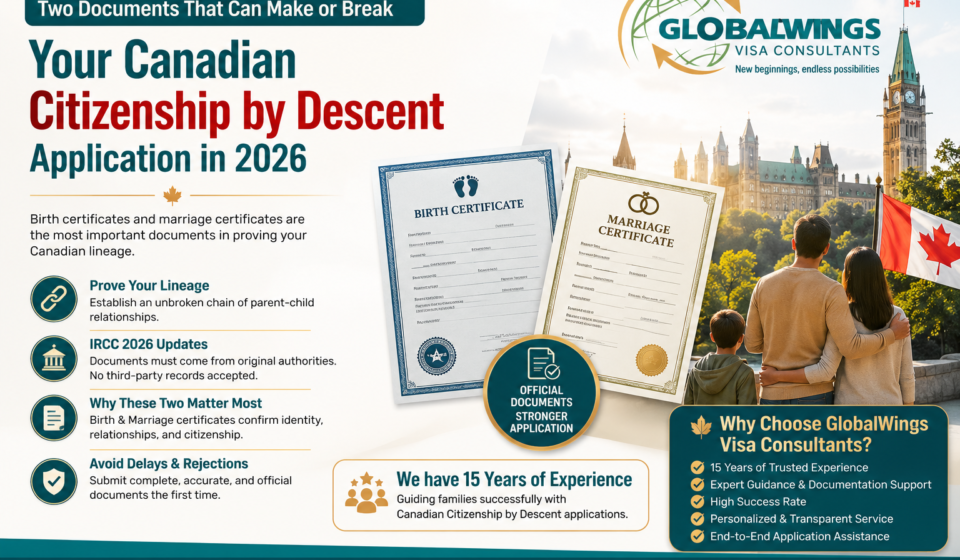

Two Documents That Can Make or Break Your Canadian Citizenship by Descent Application
If you have a Canadian parent, grandparent, or another Canadian ancestor, you may be eligible to claim Canadian citizenship by descent. However, eligibility alone isn’t enough—you must provide the right documents to prove your family connection.
One of the most common reasons citizenship applications are delayed or returned is insufficient documentation. Immigration, Refugees and Citizenship Canada (IRCC) has introduced stricter documentation requirements in 2026, making it more important than ever to submit official records from the correct authorities.
At Globalwings Visa Consultants, we have 15 years of experience helping individuals and families navigate Canadian immigration and citizenship applications. Our experienced consultants assist applicants in collecting the right documents, preparing accurate applications, and avoiding costly mistakes.
In this guide, we’ll explain why birth certificates and marriage certificates are the two most important documents in a Canadian citizenship by descent application, along with the latest IRCC documentation rules.
What Is Canadian Citizenship by Descent?
Canadian citizenship by descent allows eligible individuals born outside Canada to claim Canadian citizenship through a Canadian parent or, in some cases, another qualifying ancestor, depending on Canadian citizenship laws.
To receive citizenship, applicants must prove an unbroken family relationship linking themselves to their Canadian ancestor. Every generation in that family line must be supported with official documentation.
Think of it as building a chain. Every document represents one link, and if one link is missing or incorrect, your application may be delayed or refused.
Why Documentation Is More Important Than Ever in 2026
IRCC has strengthened its documentation requirements for citizenship by descent applications.
Applicants must now provide documents issued directly by the original authority responsible for maintaining those records.
Examples include:
- Provincial or territorial vital statistics offices
- Civil registration offices
- Government archives
- Official record repositories
Documents downloaded from genealogy websites or family history databases can help locate information but are not accepted as primary evidence.
This means applicants should begin gathering official records as early as possible.
Birth Certificates: The Foundation of Your Citizenship Claim
The birth certificate is often the most valuable document in a citizenship by descent application.
It serves several purposes simultaneously.
1. It Proves Parent-Child Relationships
A long-form birth certificate identifies:
- Child’s full name
- Date of birth
- Place of birth
- Father’s name
- Mother’s name
This establishes the legal relationship between generations.
2. It Confirms Canadian Citizenship
If your ancestor was born in Canada, their provincial or territorial birth certificate generally confirms Canadian citizenship because Canada grants citizenship to most individuals born on Canadian soil.
This single document often proves both identity and citizenship.
3. It Helps Locate Additional Records
Birth certificates frequently contain valuable information such as:
- Parents’ names
- Maiden names
- Parish details
- Municipality
- Registration numbers
These details make it much easier to locate marriage records, baptism records, census documents, and other historical evidence.
Long-Form Birth Certificates Are Preferred
Whenever possible, applicants should obtain the long-form birth certificate.
Unlike short-form certificates, long-form versions include parents’ names and other essential family details that IRCC uses to verify lineage.
What If a Birth Certificate Doesn’t Exist?
Some older records may never have been officially registered.
In such cases, IRCC may accept alternative records issued by official authorities, including:
- Certified baptismal certificates
- Hospital birth records
- Physician records
- Midwife records
- Census records
- Passenger or immigration records
- Official archival documents
These alternatives must still come from recognised government or authorised archival institutions.
Special Rules for Quebec Records
Applicants with ancestors from Quebec should pay particular attention.
IRCC only accepts Quebec birth and marriage certificates that meet current issuance requirements.
Older certificates may need to be:
- Reissued by the Directeur de l’état civil (DEC), or
- Certified through Bibliothèque et Archives nationales du Québec (BAnQ)
Using outdated certificates could delay your application.
Marriage Certificates: The Second Most Important Document
Marriage certificates are equally important because they explain changes in family names between generations.
Many citizenship by descent applications involve family members whose surnames changed after marriage.
Without a marriage certificate, IRCC may be unable to connect two documents belonging to the same person.
Marriage Certificates Connect Family History
For example:
- Mary Thompson marries John Wilson.
- She later appears as Mary Wilson on her child’s birth certificate.
Without the marriage certificate, there may be no official evidence showing these two names belong to the same individual.
The marriage certificate creates that legal connection.
Marriage Records Can Reveal Name Changes
Many immigrant families changed surname spellings over time.
Examples include:
- Boucher → Bushey
- Lévesque → Lavesque
- Schmidt → Smith
Marriage records often document these spelling variations, making it easier to establish continuous family relationships.
Marriage Certificates Can Also Establish Citizenship Eligibility
In certain historical situations, marriage itself may affect citizenship status.
For example, women who married Canadian-born or naturalised British men before specific historical dates may need marriage certificates as primary evidence.
These cases require particularly careful document preparation.
Every Generation Must Be Documented
A successful citizenship by descent application requires documentation for every generation.
For example:
Canadian Grandparent
↓
Parent’s Birth Certificate
↓
Marriage Certificate (if applicable)
↓
Applicant’s Birth Certificate
Each document supports the next, creating a continuous chain connecting the applicant to their Canadian ancestor.
What If Records Cannot Be Found?
Many applicants worry because records are old or appear to be missing.
IRCC understands that some historical documents may no longer exist.
However, applicants must now demonstrate that they made genuine efforts to locate them.
Useful supporting evidence includes:
- Archive correspondence
- No-record certificates
- Official search confirmations
- Government letters explaining unavailable records
Simply stating that documents are missing is no longer sufficient.
Start With Your Canadian Ancestor
Many applicants feel overwhelmed when beginning their search.
The easiest strategy is to begin with the closest known Canadian ancestor.
Once you obtain that person’s:
- Birth certificate
- Marriage certificate
- Family information
finding the next generation usually becomes much easier.
Each official document provides names, locations, and dates that simplify future searches.
Common Mistakes Applicants Should Avoid
Avoid these common errors that often delay citizenship by descent applications:
- Using unofficial genealogy website printouts
- Submitting short-form birth certificates
- Missing marriage certificates after surname changes
- Providing uncertified copies
- Ignoring Quebec-specific documentation rules
- Leaving gaps between generations
- Failing to document unsuccessful record searches
Careful preparation significantly improves the likelihood of a successful application.
Why Choose Globalwings Visa Consultants?
Applying for Canadian citizenship by descent can be a lengthy and document-intensive process. Professional guidance helps reduce delays and ensures your application is complete before submission.
Globalwings Visa Consultants has 15 Years of Experience
At Globalwings Visa Consultants, we have 15 years of experience assisting individuals and families with Canadian immigration and citizenship matters.
Our experienced team understands the latest IRCC documentation standards and helps applicants prepare strong, accurate applications.
We Help You With:
- Canadian Citizenship by Descent applications
- Document verification
- Family lineage assessment
- Birth and marriage record guidance
- Application preparation
- IRCC documentation compliance
- Alternative document advice for missing records
- End-to-end application support
Our goal is to simplify the process while minimising delays and avoiding documentation errors.
Canadian citizenship by descent is about proving your family history through official records. While many documents may be requested, birth certificates and marriage certificates form the backbone of nearly every successful application.
With IRCC’s stricter documentation requirements introduced in 2026, obtaining official records from authorised government sources has become more important than ever.
If you’re unsure where to begin or need help locating documents, professional guidance can make the process far easier.
Globalwings Visa Consultants has 15 years of experience helping clients prepare complete and accurate Canadian immigration and citizenship applications. Our team is committed to guiding you through every stage of your citizenship by descent journey with confidence and professionalism.
Frequently Asked Questions (FAQs)
1. What is Canadian citizenship by descent?
Canadian citizenship by descent allows eligible individuals born outside Canada to claim Canadian citizenship through a qualifying Canadian parent or ancestor under applicable citizenship laws.
2. Which documents are most important for citizenship by descent?
The two most important documents are birth certificates and marriage certificates, as they establish family relationships across generations.
3. Does IRCC accept genealogy website records?
No. Genealogy websites may assist with research, but IRCC requires official records issued by the original government authority or archive.
4. What if my ancestor’s birth certificate is unavailable?
IRCC may accept certified alternatives such as baptismal records, hospital records, census records, or official archival documents, provided they come from recognised authorities.
5. Why are marriage certificates necessary?
Marriage certificates explain legal surname changes and connect family members across different documents, helping establish an uninterrupted family lineage.
6. Can missing records delay my application?
Yes. Missing documents can delay processing unless you provide evidence that you made reasonable efforts to obtain them, such as archive correspondence or a no-record certificate.
7. How long does a Canadian citizenship by descent application take?
Processing times vary based on IRCC workloads and the completeness of your application. Submitting accurate documentation can help avoid unnecessary delays.
8. Why should I choose Globalwings Visa Consultants?
With 15 years of experience, Globalwings Visa Consultants provides expert guidance for Canadian citizenship by descent applications, helping clients prepare accurate documentation, avoid common mistakes, and navigate the application process with confidence.