
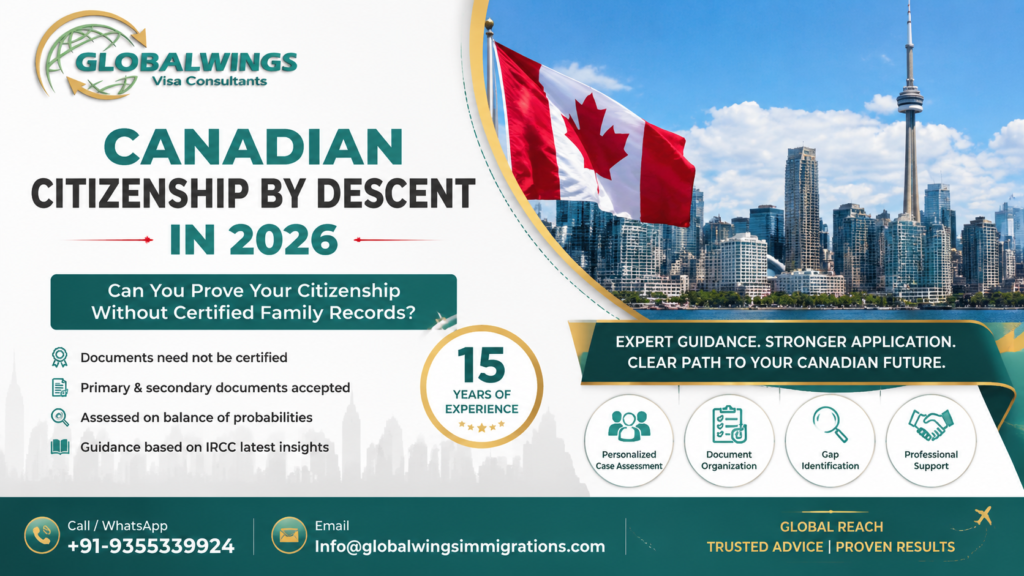
Canadian Citizenship by Descent in 2026: Can You Prove Your Citizenship Without Certified Family Records?

If you are trying to prove Canadian citizenship by descent, you may be wondering whether every family record needs to be certified before you submit your application. This question has become especially important for applicants who are tracing their Canadian ancestry through older birth certificates, baptismal records, marriage certificates, census records, immigration documents, or naturalization records.
Recent guidance discussed by Immigration, Refugees and Citizenship Canada (IRCC) indicates that documents do not automatically need to be certified for a proof of citizenship application. However, the origin and reliability of the document remain important. An immigration officer can request a certified copy if there are concerns about authenticity.
For people applying through a family connection to Canada, the bigger issue is therefore not simply whether a document is certified. Applicants need to establish a credible documentary chain connecting themselves to their Canadian ancestor.
At Globalwings Visa Consultants, we help applicants understand the documentation requirements and organize their immigration or citizenship-related applications with a structured approach. With 15 years of experience, our team focuses on helping clients identify documentation gaps, understand application requirements, and prepare their cases carefully.
What Is Canadian Citizenship by Descent?
Canadian citizenship by descent generally involves proving a family connection to a Canadian citizen through one or more generations. Depending on the circumstances, an applicant may need to demonstrate the relationship between themselves, their parent, grandparent, great-grandparent, or another relevant ancestor.
The documentary evidence becomes particularly important when the claim involves several generations. A person may have a Canadian ancestor but still need to provide records showing how that ancestor is connected to each generation leading to the applicant.
IRCC’s recent guidance divides documentary evidence into primary and secondary documents. Applicants are expected to provide appropriate evidence for the family line, while officers can consider additional relevant evidence when assessing an application.
Do Family Records Have to Be Certified?
One of the most important points in the recent guidance is that certification is not formally required for every document.
IRCC’s presentation states that documents supporting a proof of citizenship application do not need to be certified. However, an officer may request a certified copy if there is doubt about whether a document is authentic.
This means applicants should not assume that an uncertified document is automatically unacceptable.
Instead, attention should be given to the source of the record.
IRCC guidance indicates that documents should come from the original authority that created, issued, or currently maintains the record. Depending on the document, this could include a civil registry, vital statistics authority, archive, or another organization responsible for maintaining historical records. Paper applications should contain clear colour copies, while online applications should use high-resolution colour scans or digital images.
Therefore, an original-source document that is not certified may be more useful than a third-party copy whose origin cannot be established.
Primary Documents for Canadian Citizenship by Descent
Primary documents form the stronger part of the documentary chain. According to the guidance discussed in the source material, examples include:
- Canadian provincial or territorial birth certificates
- Foreign birth certificates showing parent-child relationships
- Canadian citizenship or naturalization certificates
- Certificates of Registration of Birth Abroad
- Certificates of Retention of Canadian Citizenship
- Certain British naturalization records issued in Canada or Newfoundland and Labrador
- Proof of British subject status in relevant historical circumstances
The exact documents required can depend on the applicant’s circumstances and the generations involved.
The key objective is to demonstrate the relationship between each generation rather than simply submitting one old Canadian document and assuming that it proves the entire claim.
What Are Secondary Documents?
Secondary documents can provide additional evidence supporting a citizenship-by-descent claim.
Examples mentioned in the guidance include:
- Baptismal records
- Hospital birth records
- Records from physicians or midwives
- Census records
- Canada Gazette records
- Marriage records
- Death records
- Immigration records
- Military records
- Boat manifests
- Passports
These records can be particularly useful when historical documentation is difficult to obtain.
However, applicants should understand an important distinction: secondary evidence does not necessarily replace primary evidence when appropriate primary documentation exists.
For example, a baptismal record issued by the organization that created and maintains the record may provide meaningful supporting evidence. On the other hand, a screenshot or printout from a genealogy website may not establish the same level of documentary reliability.
What If Your Documents Are Not Certified?
If your family records are not certified, there is no need to assume immediately that your Canadian citizenship by descent application will fail.
Instead, review the documents according to their source and relevance.
You may have a strong case if you possess primary documents from the appropriate authorities for every generation between you and your Canadian ancestor. If your records contain consistent names, dates, and relationships, your documentary chain may be easier to establish.
You may also have useful supporting evidence if some generations are documented through secondary records.
The situation becomes more complicated when there is a missing generation, inconsistent information, or documents obtained only from third-party sources.
For example, a family tree downloaded from a genealogy website may help you locate historical information, but it should not automatically be treated as official evidence. The source material specifically notes that third-party records cannot form the sole basis of a claim.
What If Names or Dates Do Not Match?
Historical family records often contain spelling differences, different versions of names, or inconsistent dates.
A person could be recorded under one name on a birth record and another on a marriage document. Similarly, an ancestor’s birth year may differ between records.
These discrepancies should not simply be ignored.
The source material explains that IRCC assesses citizenship claims on a balance of probabilities, meaning the officer considers whether the claim is more likely true than not based on the evidence submitted.
Where records conflict, applicants may need additional evidence such as:
- Marriage certificates
- Name-change records
- Additional civil records
- Immigration documents
- Historical records
- A clear written explanation of the discrepancy
The purpose is to create a logical and credible connection between the documents.
Canada Gazette Records May Help Some Applicants
An interesting source of historical evidence highlighted in the guidance is the Canada Gazette.
According to the presentation discussed in the source material, the Canada Gazette published names of people who were naturalized in Canada up to 1952. Library and Archives Canada maintains historical lists covering relevant periods, including searchable material for certain years.
This may be particularly useful when an applicant’s ancestor is believed to have naturalized in Canada but the original naturalization certificate is no longer available.
However, a Gazette entry is considered supporting evidence rather than a replacement for every type of primary document.
Applicants should also understand that people born in Canada generally did not need to naturalize, so they would not necessarily appear in these historical naturalization lists.
Is a “No Record Found” Letter Necessary?
Another important point concerns situations where an applicant cannot locate a historical record.
The source material reports that, according to the Association of Canadian Archivists’ summary of the IRCC session, a formal or certified “No Record Found” letter may not always be required. Evidence showing that the applicant attempted to locate the document may help demonstrate the steps taken to obtain it.
However, the presentation itself emphasizes that applicants who cannot source an original record should explain in writing the efforts made to locate it and why the document cannot be provided.
A formal no-record letter can still be useful where available.
Because documentation requirements can change, applicants should verify the current requirements before submitting a citizenship application.
How to Check Whether Your Citizenship-by-Descent File Is Ready
Before applying, consider placing your records into three broad categories.
1. Complete documentary chain:
You have appropriate documents connecting each generation between yourself and your Canadian ancestor, with consistent names and dates.
2. Supporting evidence available:
You have primary documents for most generations and secondary records supporting areas where additional evidence is needed.
3. Documentation gaps:
A generation is supported only by third-party information, an important record cannot be located, or names and dates conflict without an explanation.
The third situation deserves careful attention before submission. Identifying a problem early can be much easier than discovering a documentation gap after the application has already been submitted.
Why Choose Globalwings Visa Consultants?
Choosing the right immigration consultant can make a significant difference when your case involves complex family documentation, historical records, or multiple generations.
Globalwings Visa Consultants brings 15 years of experience in the immigration and visa consulting field. Our approach is centered on understanding the applicant’s individual circumstances rather than treating every case in exactly the same way.
Case assessment: We review your circumstances and identify the relevant documentation and potential issues.
Document organization: We help you understand how different records can support your application and where additional evidence may be required.
Gap identification: If there is a missing generation, inconsistent name, unavailable record, or other documentation concern, identifying it early can help you plan the next step.
Application guidance: We provide structured guidance throughout the preparation process so that important requirements are not overlooked.
Experienced support: With 15 years of experience, Globalwings Visa Consultants understands that immigration and citizenship-related applications can involve detailed documentation and individual circumstances.
Our objective is to make the process clearer and more organized while helping applicants make informed decisions about their applications.
If you have an old family record that is not certified, do not assume that you are automatically unable to prove Canadian citizenship by descent.
Recent IRCC guidance indicates that certification is not formally required for every supporting document. What matters is whether the evidence comes from an appropriate source, whether it establishes the relevant family relationship, and whether the complete documentary picture supports the citizenship claim.
Primary documents remain important, while secondary records can provide additional support. Historical records such as baptismal documents, census information, immigration records, marriage certificates, and Canada Gazette entries may become valuable when researching older generations.
Most importantly, applicants should not rely solely on genealogy websites or other third-party sources when official records are available.
If you are unsure whether your family documents are sufficient for a Canadian citizenship by descent claim, a professional review can help you identify documentation gaps before you proceed.
Frequently Asked Questions
Q1. Do Canadian citizenship-by-descent documents need to be certified?
No. The recent guidance discussed in the source material states that documents do not formally need to be certified, although an officer may request a certified copy if authenticity is questioned.
Q2. Can a baptismal record support a citizenship-by-descent application?
Yes, baptismal records are identified as secondary evidence. Their value can depend on whether they originate from the authority that created or maintains the record.
Q3. Can a genealogy website record prove Canadian citizenship by descent?
Third-party genealogy records should not be relied upon as the sole evidence of a citizenship claim. Applicants should seek records from the original authority where possible.
Q4. What does “balance of probabilities” mean?
It means the officer assesses whether the citizenship claim is more likely true than not based on the information and evidence provided.
Q5. What should I do if an ancestor’s record cannot be found?
Document the efforts made to locate the record and explain why it cannot be provided. The source material indicates that a formal “No Record Found” letter may not always be required, although it can still be useful when available.
Q6. Should I apply if there are inconsistencies in my family records?
It is better to identify and address inconsistencies before submitting the application. Supporting documents and explanations may help establish the connection between generations.
Contact Globalwings Visa Consultants
Phone: +91-9355339924
Email: Info@globalwingsimmigrations.com
Globalwings Visa Consultants – Helping You Navigate Your Immigration Journey With Experience and Professional Guidance.