
Do you have Canadian ancestry but struggle to find the historical documents needed to establish your family connection? Applying for Canadian citizenship by descent may require more than knowing that a parent, grandparent, or distant ancestor was born in Canada. Applicants may need official records that establish an unbroken link between their Canadian ancestor and themselves.
Genealogy websites, historical newspapers, census databases, and archival collections can help applicants discover missing information about their family history. These resources are especially useful when birth certificates are unavailable, surnames have changed over time, or older family records are difficult to locate.
For individuals exploring their Canadian citizenship eligibility, understanding where to search and which documents to obtain can make the research process more organised.
In this guide, Globalwings Visa Consultants explains five useful tools for tracing Canadian ancestors, finding historical records, and preparing for a potential application for proof of Canadian citizenship.
What Is Canadian Citizenship by Descent?
Canadian citizenship by descent refers to citizenship acquired through a qualifying family connection to a Canadian citizen, subject to the applicable Canadian citizenship laws.
Having a Canadian-born ancestor does not automatically establish eligibility in every situation. Your date and place of birth, your family lineage, the citizenship status of relevant relatives, and the legal rules applicable to your circumstances may all affect the outcome.
Changes to Canada’s citizenship-by-descent legislation took effect on December 15, 2025. The rules may allow certain people born before that date to establish citizenship through a Canadian ancestor several generations back, depending on the circumstances. Eligibility must be assessed against the applicable legislation and any relevant exceptions.
If you believe you may qualify, the first step is to establish your family tree and identify the ancestor through whom your potential claim arises.
Why Are Historical Records Important for Canadian Citizenship?
When an application depends on family ancestry, each generation between the Canadian ancestor and the applicant may need to be documented.
For example, if you believe your great-grandparent was Canadian, you may need records connecting that great-grandparent to your grandparent, your parent, and yourself.
Useful documents may include:
- Birth certificates and registration records.
- Marriage certificates and records of name changes.
- Death certificates, where relevant.
- Baptismal or parish records.
- Census and immigration records.
- Historical newspaper announcements and obituaries.
- Official citizenship or nationality documents, where applicable.
Online genealogy platforms are useful starting points, but a database entry, family tree, or newspaper article generally does not replace the official documentation required by Immigration, Refugees and Citizenship Canada (IRCC).
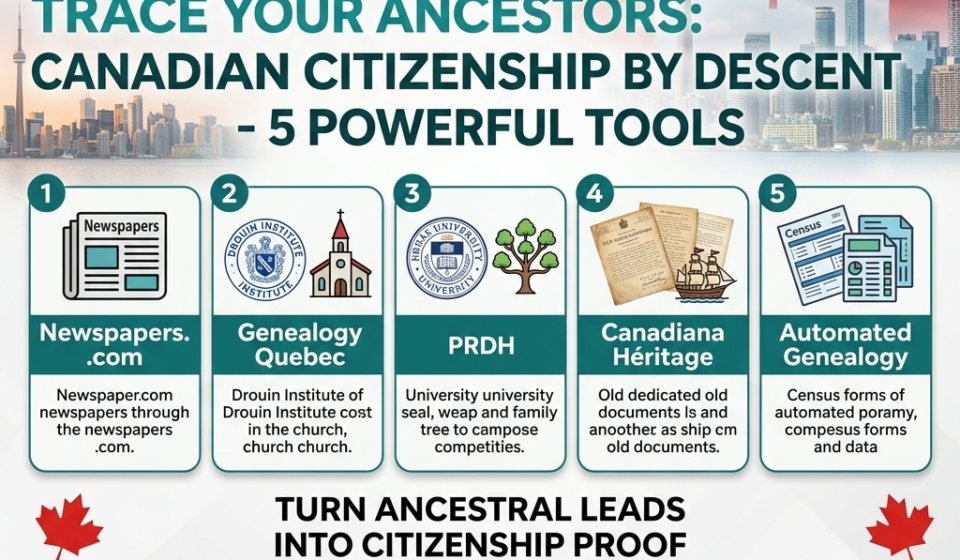
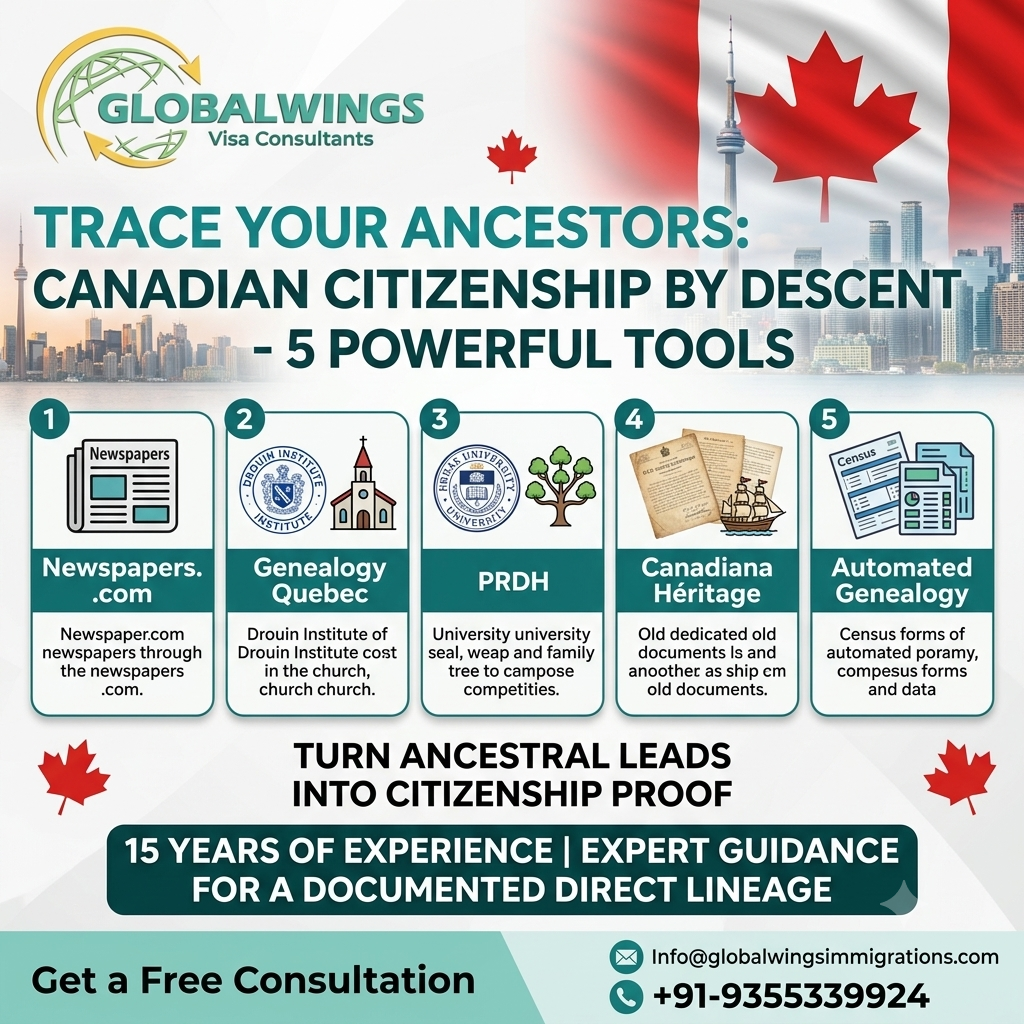
5 Tools to Help You Trace Your Canadian Ancestors
1. Newspapers.com: Find Family Names and Historical Connections
Newspapers.com is a digital newspaper archive that can help researchers uncover details about relatives who lived in Canada or the United States.
Historical newspapers may contain obituaries, marriage announcements, birth notices, family reunions, and community news. These records can reveal information that is missing from a family tree, such as a maiden name, a former residence, or the names of relatives.
For example, an obituary might identify a person’s birthplace and surviving family members. This information can help you determine which government archive, parish, or civil registry to contact next.
How to use it effectively:
- Search using your ancestor’s full name and known locations.
- Try alternative spellings and former surnames.
- Search for relatives who may have appeared in the same newspaper.
- Record dates, locations, and family relationships mentioned in the results.
Some newspapers can be browsed without a paid subscription, while full access may require payment. An obituary is a research lead rather than definitive proof of Canadian citizenship.
2. Genealogy Quebec: Explore Quebec Parish and Civil Records
If your ancestors lived in Quebec, Genealogy Quebec may be a valuable resource. Its collections include historical parish records, marriage and death information, obituaries, census material, and other genealogical documents.
Quebec’s historical records are particularly important for families whose ancestors lived in French-speaking communities. Older records may contain French names, handwritten entries, and spellings that differ from those used by later generations.
The platform can help you identify a likely marriage record, locate a parish, or discover information about an ancestor’s parents.
How to use it effectively:
- Begin with the ancestor’s full name and approximate date of birth.
- Search for spelling variations, including accented and unaccented names.
- Use available parish and location guides to narrow your search.
- Note the record’s date, location, and any reference numbers.
- Determine which official authority can issue the required document.
Some search results and guides may be available free of charge, while original record images and additional services may require a subscription.
If a record is written in French, make sure the details are interpreted accurately before using them to support an application.
3. Programme de recherche en démographie historique (PRDH): Research French-Canadian Family Lines
The Programme de recherche en démographie historique, commonly known as PRDH, is a historical population research resource associated with the Université de Montréal.
It can be particularly useful for researching French-Canadian families whose histories extend back several centuries. The database connects historical information from records such as baptisms, marriages, and burials, helping researchers distinguish between people with similar names.
This can be important when several generations share the same first name or when a family has multiple relatives with similar surnames.
How to use it effectively:
- Search for your ancestor using the name and approximate period you know.
- Review linked family information to identify parents and spouses.
- Compare dates and locations with other historical records.
- Keep a record of the documents or references you need to obtain officially.
Searching and reviewing basic result lists may be free, while accessing detailed records can involve usage fees.
PRDH is a research resource, not a citizenship decision-making authority. Any information found should be verified against official documents before it is submitted to IRCC.
4. Canadiana Héritage: Access Historical Canadian Archives
Canadiana Héritage provides online access to digitised historical material, including records from Library and Archives Canada collections.
Depending on the collection, researchers may find parish registers, immigration information, land records, military documents, and other archival material.
This resource can be especially useful when your family lived in Ontario, the Prairie provinces, the Maritimes, or other parts of Canada outside Quebec.
Some historical documents are available as scanned pages rather than searchable text. As a result, finding a particular person may require browsing records by location and year.
How to use it effectively:
- Start with the relevant historical collection or record category.
- Identify the town, province, or parish associated with your ancestor.
- Narrow the search by approximate dates.
- Examine original page images where available.
- Note the archival reference so you can request an official copy if necessary.
The platform can provide valuable clues for locating historical records. However, an online scan may not meet the formal requirements for proof of citizenship or family lineage.
5. Automated Genealogy: Search Historical Canadian Census Records
Automated Genealogy is a volunteer-supported resource that helps people search historical Canadian census records.
Its indexed collections include census information from several historical periods, including the 1851/1852, 1901, and 1911 censuses and the 1906 census of the Prairie provinces.
Census entries can provide useful details about an ancestor’s household, approximate age, birthplace, occupation, and immigration history, depending on the census year and the information recorded.
How to use it effectively:
- Search for your ancestor by name and location.
- Review other members of the household.
- Compare ages and birthplaces with information from family documents.
- Check the original census image when possible.
- Try alternate spellings if the first search produces no results.
Because some historical entries were transcribed manually, spelling mistakes or incomplete information may occur. Comparing the index with the original record can help reduce errors.
Automated Genealogy is a useful starting point for family research and does not generally require a paid subscription.
From Online Research to Official Proof of Canadian Citizenship
Finding your Canadian ancestor is only one part of the process. You must also establish the family relationships connecting that person to you and obtain documents that meet the applicable requirements.
IRCC assesses applications for proof of Canadian citizenship under Canadian law. The documents needed can vary according to the applicant’s circumstances and the generations involved.
Step 1: Build a Documented Family Tree
Start with yourself and work backwards through your parents, grandparents, and earlier generations. Record full names, dates of birth, marriages, places of residence, and any known name changes.
Mark any missing information so you can focus your research on the generations where evidence is incomplete.
Step 2: Locate Records for Each Generation
Use genealogy databases, historical newspapers, census records, and archival collections to identify possible records.
For every generation, look for evidence connecting the relevant parent to the child. If a surname changed through marriage or was recorded differently in historical documents, collect additional records that explain the difference.
Step 3: Obtain Documents from the Appropriate Authority
Online databases help you locate information, but you may need official certificates or records issued by the relevant civil registry, government department, or archive.
Quebec records require particular attention because the appropriate source may depend on the record type and date. Certain older Quebec birth or marriage certificates may not be accepted in the form originally obtained; applicants should confirm current requirements with IRCC and the relevant issuing authority.
Do not assume that a downloaded image or a privately compiled family tree will be accepted as a substitute for an official record.
Step 4: Review Your Eligibility Before Applying
Before submitting an application, review the citizenship-by-descent rules that apply to your date of birth and family circumstances.
Check whether the documents establish the required lineage, whether any discrepancies need to be explained, and whether additional evidence is necessary.
If your claim involves several generations, complex name changes, missing records, or ancestors from Quebec, professional guidance may help you identify the issues that need attention.
Common Challenges When Tracing Canadian Ancestry
Researching family history can be time-consuming, especially when records are old or incomplete. Some common challenges include:
Different spellings of names: Surnames may have changed because of translation, marriage, transcription errors, or anglicisation.
Missing birth certificates: Older generations may have been recorded in church registers rather than modern civil registration systems.
French-language records: Documents from Quebec may require careful interpretation of historical French terminology and handwriting.
Incomplete family connections: A record may identify an ancestor without clearly establishing the relationship to the next generation.
Confusion between ancestry and eligibility: Having a Canadian relative does not, by itself, guarantee citizenship. The applicable legal requirements must be satisfied.
A systematic approach can help you address these issues without relying on unverified family stories or incomplete online information.
Why Choose Globalwings Visa Consultants?
Understanding Canadian citizenship requirements and organising supporting documents can be challenging, particularly when a potential claim involves multiple generations or records from different countries.
Globalwings Visa Consultants brings 15 years of experience in immigration and visa consultancy. We aim to help clients understand their options, organise their documentation, and prepare for the next steps in their immigration-related journey.
Here is why you can consider Globalwings Visa Consultants:
- 15 years of experience: Benefit from our experience in immigration and visa consultancy.
- Guidance based on your circumstances: Understand the questions to consider before pursuing an immigration or citizenship-related application.
- Document preparation support: Organise available records and identify gaps that may require further attention.
- Clear communication: Receive guidance on the next steps and the documents you may need to obtain.
- Personalised assistance: Discuss your circumstances and determine what type of professional support may be appropriate.
Citizenship eligibility and final decisions rest with the relevant Canadian authorities. Our role is to provide consultancy and document-preparation guidance within the scope of the services agreed with you.
If you believe you have a Canadian ancestor, contact Globalwings Visa Consultants to discuss your circumstances and the steps you may need to take.
Frequently Asked Questions (FAQs)
1. Can I obtain Canadian citizenship through a distant ancestor?
Possibly. Canadian citizenship-by-descent rules changed on December 15, 2025, and certain individuals may qualify through an ancestor several generations back. Your eligibility depends on the applicable law, your birth date, and your documented family history.
2. Which documents are required for Canadian citizenship by descent?
Depending on your circumstances, you may need birth certificates, marriage records, documents explaining name changes, and evidence establishing the connection between each generation and the Canadian ancestor. IRCC determines the applicable documentary requirements.
3. Can genealogy websites prove Canadian citizenship?
Genealogy websites can help locate useful information, but their entries and family trees do not automatically constitute official proof. You may need records issued by the relevant government authority, civil registry, or archive.
4. What if I cannot find my ancestor’s birth certificate?
Try searching historical census records, parish registers, immigration files, newspapers, and archival databases. These sources may help you identify where the original record is held. Contact the relevant authority to learn whether an official record or another form of evidence is available.
5. Are Quebec historical records useful for citizenship applications?
Yes. Quebec parish and civil records can help establish family relationships. However, the format, date, and issuing authority matter. Confirm which version of a record is acceptable before submitting it to IRCC.
6. Can Indians apply for proof of Canadian citizenship by descent?
An applicant living in India may be able to apply if they meet the applicable Canadian citizenship requirements. Residence in India does not by itself determine eligibility. The applicant must establish the relevant citizenship claim and provide the required documentation.
7. How can Globalwings Visa Consultants help?
Globalwings Visa Consultants can discuss your circumstances, provide consultancy within the scope of its services, and help you understand documentation and preparation steps. Eligibility decisions are made by the appropriate Canadian authorities
Tracing a Canadian ancestor can be the first step towards discovering whether you may qualify for Canadian citizenship by descent. Resources such as Newspapers.com, Genealogy Quebec, PRDH, Canadiana Héritage, and Automated Genealogy can help you find historical information and identify records worth pursuing.
However, successful research requires more than finding a name in an online database. You must establish the connection between generations, obtain the appropriate official documents, and assess your circumstances under the Canadian citizenship rules that apply to you.
If you are unsure where to begin, Globalwings Visa Consultants can help you understand the documentation and consultancy steps relevant to your situation.
Contact Globalwings Visa Consultants today to discuss your immigration or citizenship-related queries.
Phone : +91-9355339924
Email: Info@globalwingsimmigrations.com