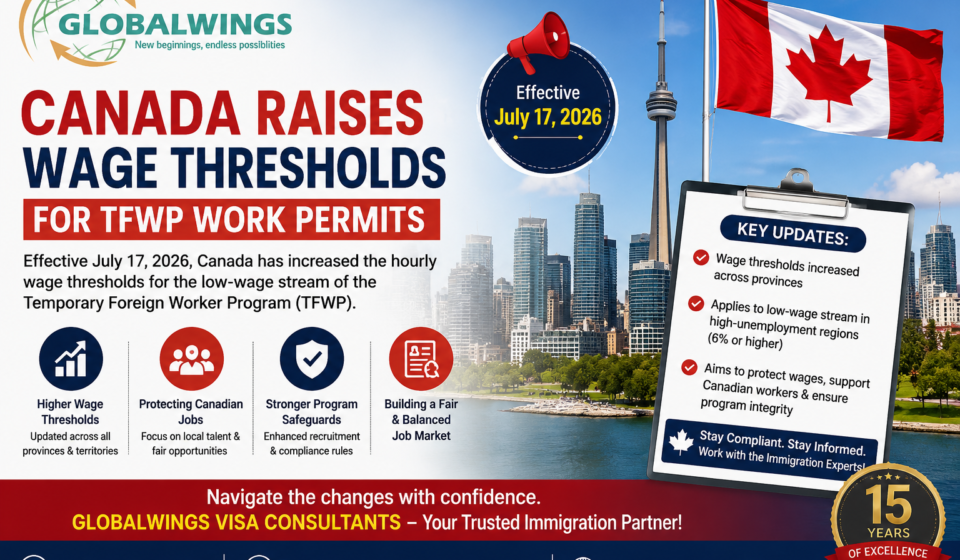

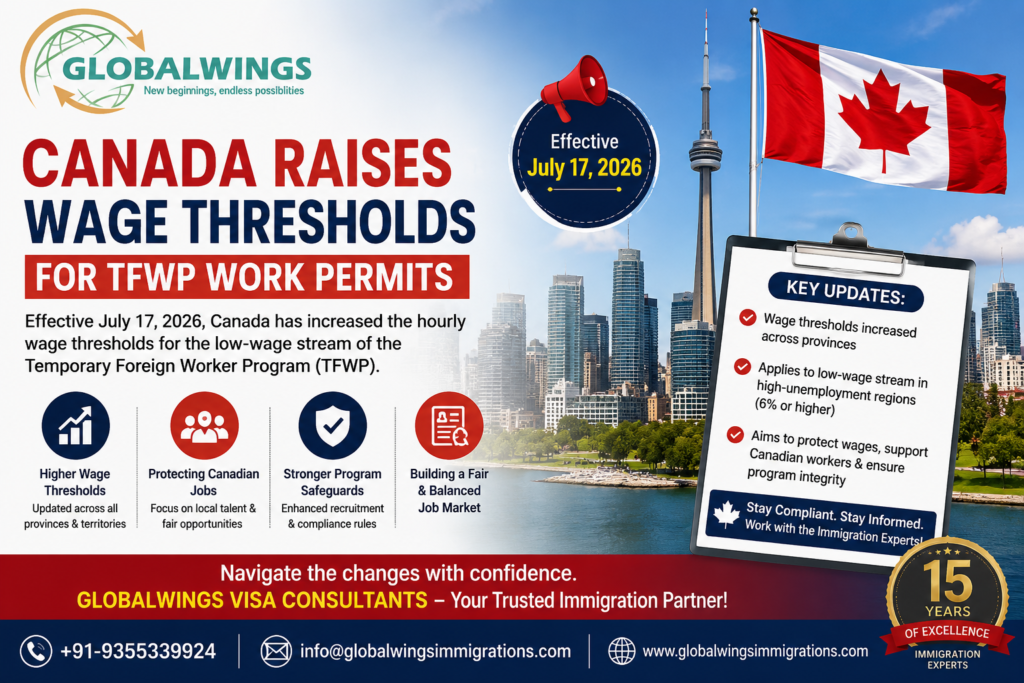
Canada has introduced significant changes to the Temporary Foreign Worker Program (TFWP) by increasing the wage thresholds for the low-wage stream. These new rules came into effect on July 17, 2026, and are expected to impact both Canadian employers and foreign workers seeking employment opportunities across the country.
The revised wage requirements are part of the Canadian government’s ongoing efforts to prioritize local hiring while ensuring fair wages for temporary foreign workers.
If you are planning to work in Canada or an employer looking to hire international talent, understanding these updates is essential.
What Has Changed in the Temporary Foreign Worker Program?
Beginning July 17, 2026, employers must meet new hourly wage thresholds when hiring workers under the Low-Wage Stream of the Temporary Foreign Worker Program.
The wage thresholds are calculated at 120% of the median provincial or territorial wage, making it more difficult for employers in certain regions to hire foreign workers for lower-paying jobs.
These updates mainly affect employers applying for or renewing Labour Market Impact Assessments (LMIAs) for low-wage positions.
Updated Provincial Wage Thresholds (Effective July 17, 2026)
| Province/Territory | New Hourly Wage | Previous Wage |
|---|---|---|
| Alberta | $37.50 | $36.00 |
| British Columbia | $38.40 | $36.60 |
| Manitoba | $31.33 | $30.16 |
| New Brunswick | $31.73 | $30.00 |
| Newfoundland & Labrador | $33.60 | $32.40 |
| Northwest Territories | $48.00 | $48.00 |
| Nova Scotia | $31.96 | $30.00 |
| Nunavut | $45.00 | $42.00 |
| Ontario | $36.92 | $36.00 |
| Prince Edward Island | $31.20 | $30.00 |
| Quebec | $36.00 | $34.62 |
| Saskatchewan | $34.62 | $33.60 |
| Yukon | $45.60 | $44.40 |
Employers offering wages below these thresholds may no longer qualify under the low-wage stream in many parts of Canada.
Work Permit Restrictions in High-Unemployment Areas
The Canadian government continues to restrict new and renewed low-wage TFWP applications in metropolitan regions where the unemployment rate is 6% or higher.
Several major cities currently affected include:
- Toronto
- Ottawa-Gatineau
- Montreal
- Hamilton
- London
- Oshawa
- Windsor
- Calgary
- Edmonton
- Vancouver
- Kelowna
- Abbotsford-Mission
- Saskatoon
- Moncton
- St. John’s
- Peterborough
- Barrie
- Chilliwack
- Kamloops
- Guelph
- Brantford
- Greater Sudbury
- Red Deer
Employers located in these regions generally cannot submit new or renewal LMIA applications for positions paying below the updated wage threshold.
Additional Requirements for Employers Using the Low-Wage Stream
Employers located outside restricted regions can still hire foreign workers under the low-wage stream, but they must comply with several additional requirements.
These include:
- Limiting temporary foreign workers to 10% of the workforce at each work location.
- Some sectors such as construction and food manufacturing may qualify for a 20% workforce cap.
- Rural employers in participating provinces may temporarily hire up to 15% under a federal measure running until March 31, 2027.
- Advertise positions for a minimum of eight weeks.
- Conduct recruitment efforts targeting underrepresented groups, including Indigenous people and persons with disabilities.
- Promote employment opportunities for youth aged 15 to 30 years.
- Invite qualified Job Bank candidates meeting the required matching criteria.
- Provide suitable and affordable accommodation where required.
- Cover round-trip transportation costs for temporary foreign workers.
These measures are intended to encourage employers to hire Canadians first while ensuring responsible recruitment of international workers.
Understanding the Temporary Foreign Worker Program (TFWP)
The Temporary Foreign Worker Program (TFWP) enables Canadian employers to recruit qualified foreign workers when no Canadian citizen or permanent resident is available to fill a position.
To hire through the TFWP, employers generally need:
- A positive or neutral Labour Market Impact Assessment (LMIA).
- Proof that sufficient efforts were made to recruit Canadian workers.
- Compliance with wage, working conditions, and employment standards.
A work permit issued under the TFWP is employer-specific, meaning workers are authorized to work only for the employer and position listed on their work permit.
Wage Protection for Temporary Foreign Workers
Regardless of whether a position falls under the high-wage or low-wage stream, employers must pay the higher of:
- The prevailing regional wage for the occupation, or
- The wage paid to Canadian citizens or permanent residents performing the same work in the same location.
This policy is designed to maintain fair wages and prevent wage suppression in the Canadian labour market.
Why Canada Is Tightening TFWP Rules
Over the past few years, Canada has introduced several reforms to strengthen the Temporary Foreign Worker Program.
Key changes include:
- Increasing wage thresholds for low-wage occupations.
- Restricting low-wage LMIAs in areas with higher unemployment.
- Reducing employer workforce caps for temporary foreign workers.
- Setting annual admission targets for temporary residents.
- Enhancing employer compliance requirements.
These reforms aim to balance Canada’s labour shortages with the protection of domestic employment opportunities.
Temporary Resident Admission Targets
Canada has also reduced its temporary resident admissions in recent years.
For 2026, the federal government plans to admit approximately:
- 60,000 Temporary Foreign Worker Program (TFWP) work permit holders
- 170,000 International Mobility Program (IMP) work permit holders
Unlike the TFWP, the International Mobility Program (IMP) does not usually require an LMIA because it supports broader economic, cultural, and international objectives.
What These Changes Mean for Foreign Workers
If you are planning to work in Canada under the Temporary Foreign Worker Program, these updates may affect your job search and eligibility.
Foreign workers should:
- Focus on employers offering wages above the new provincial thresholds.
- Ensure employers have valid LMIA approval where required.
- Explore opportunities under both the TFWP and International Mobility Program.
- Stay informed about changing provincial labour market conditions.
Working with experienced immigration professionals can help applicants understand the latest requirements and prepare strong work permit applications.
Why Choose Globalwings Visa Consultants?
At Globalwings Visa Consultants, we have over 15 years of experience helping individuals achieve their Canadian immigration goals. Our experienced team provides personalized guidance for work permits, LMIA-based employment, visitor visas, permanent residence pathways, and other immigration services.
Our services include:
- Complete Canada Work Permit assistance
- LMIA guidance and documentation support
- Eligibility assessment
- Visa application preparation
- Document verification
- End-to-end application support
- Professional immigration consultation
We stay updated with the latest Canadian immigration policies so our clients receive accurate and reliable guidance throughout the application process.
Contact Globalwings Visa Consultants
If you’re planning to work in Canada and want expert guidance on the latest Temporary Foreign Worker Program (TFWP) updates, our team is here to help.
Phone: +91-9355339924