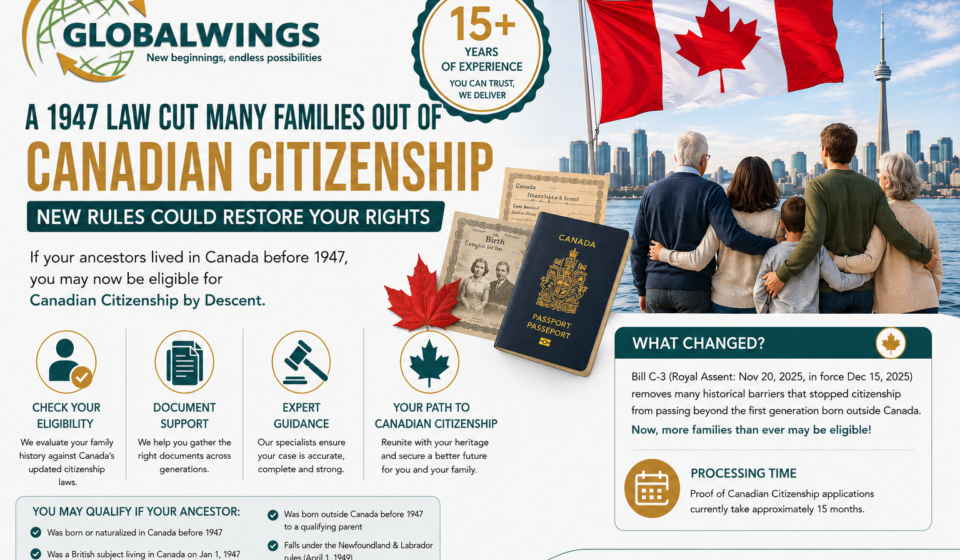
A 1947 Law Cut Many Families Out of Canadian Citizenship—How Canada’s New Rules Could Restore Citizenship by Descent

A 1947 Law Cut Many Families Out of Canadian Citizenship—Canada’s New Citizenship Rules Could Change Everything
For many families around the world, Canadian roots have remained part of their family history for generations. However, thousands of descendants were unknowingly excluded from Canadian citizenship because of laws introduced decades ago.
If your parents, grandparents, or great-grandparents were born in Canada before 1947, you may now have an opportunity to reclaim your Canadian citizenship through recent amendments to Canada’s Citizenship Act.
Canada has introduced significant legislative changes that address historical unfairness affecting many descendants of Canadian-born ancestors. These changes have reopened citizenship pathways for individuals whose family lines were previously cut off because of outdated citizenship laws.
At GlobalWings Visa Consultants, we have over 15 years of experience helping individuals and families navigate complex Canadian immigration and citizenship matters. Our experienced team carefully reviews every family history and assists clients throughout the citizenship by descent application process.
In this guide, we’ll explain everything you need to know about Canada’s updated citizenship rules, eligibility requirements, required documents, and how you can determine whether you qualify.
Understanding Canada’s First Citizenship Law
Before January 1, 1947, there was no separate Canadian citizenship.
People living in Canada were legally considered British subjects. Everything changed when Canada introduced its first Citizenship Act on January 1, 1947.
Although the new law officially created Canadian citizenship, it also introduced several restrictive rules that unintentionally excluded many individuals and their future descendants.
As a result, thousands of families lost the opportunity to pass Canadian citizenship through future generations.
Fortunately, Canada’s government has gradually corrected many of these historical injustices through amendments to the Citizenship Act.
Why Did So Many Families Lose Canadian Citizenship?
Several provisions in the original 1947 Citizenship Act prevented citizenship from passing naturally through certain family lines.
The two most significant situations involved:
1. Canadian Women Who Married Foreign Nationals
One of the most controversial provisions affected Canadian-born women.
Before 1947, a Canadian woman who married a non-Canadian often automatically lost her British subject status because, under the law at the time, a wife’s nationality followed her husband’s.
This meant that:
- Canadian-born women could lose their legal status.
- Their children born outside Canada often couldn’t inherit Canadian citizenship.
- Future generations unknowingly lost their citizenship rights.
Many families today discover that their Canadian ancestry runs through a grandmother or great-grandmother whose citizenship disappeared simply because of marriage.
2. British Subjects Living in Canada Before 1947
Another group affected included British subjects who:
- Were born in Canada before 1947,
- Were naturalized before Canadian citizenship existed,
- Or lived in Canada for many years.
Many of these individuals did not automatically become Canadian citizens on January 1, 1947 because they failed to meet specific residency requirements introduced under the new law.
As a result, entire family lines were excluded from citizenship.
Who May Qualify Under Today’s Citizenship Rules?
Canada has amended its Citizenship Act several times to recognize many of these historically excluded individuals.
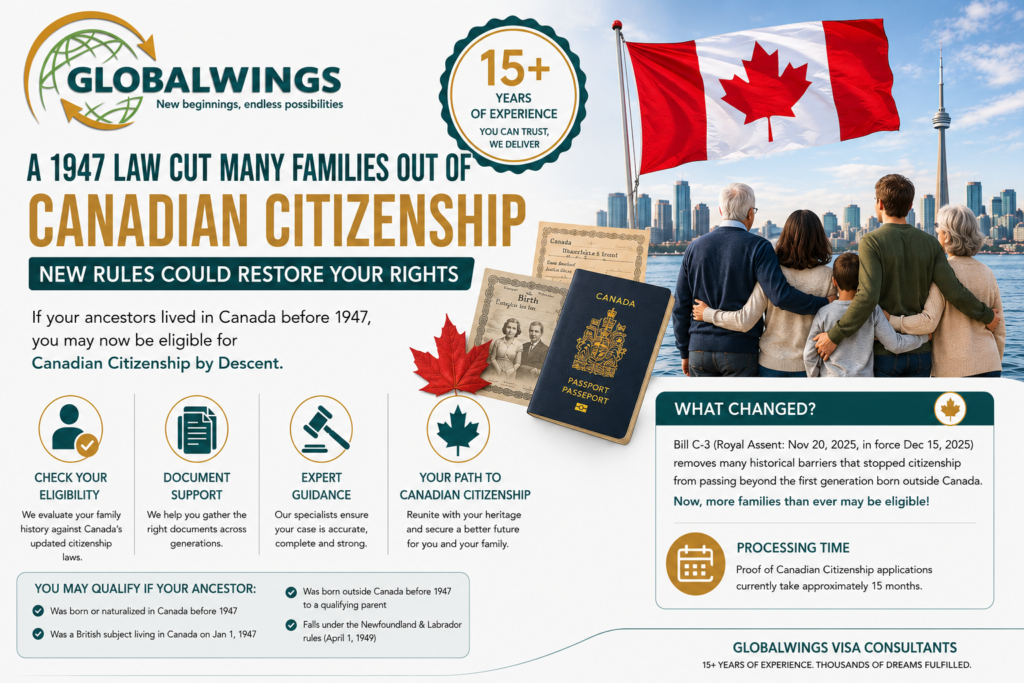
You may now have a valid citizenship by descent claim if your ancestor falls into one of these categories:
- Born in Canada before January 1, 1947 but did not automatically become a Canadian citizen.
- Naturalized in Canada before 1947 and later excluded under the old law.
- A British subject living in Canada on January 1, 1947 who did not become a citizen.
- Born outside Canada before 1947 to a qualifying Canadian parent.
- Descended from an individual whose citizenship has now been restored through legislative amendments.
If your family history includes any of these situations, your eligibility deserves careful review.
Special Rules for Newfoundland and Labrador
Newfoundland and Labrador became part of Canada on April 1, 1949, rather than in 1947.
Because of this, Canada’s Citizenship Act contains separate eligibility rules for individuals connected to Newfoundland and Labrador.
These provisions generally apply to:
- Individuals born there before April 1, 1949.
- British subjects ordinarily resident there before joining Canada.
- Children born abroad to qualifying parents from Newfoundland and Labrador.
Families with ancestry from Newfoundland should follow these separate citizenship provisions.
Bill C-3: A Major Step Toward Restoring Citizenship
One of the most important developments came with Bill C-3, which received Royal Assent in late 2025.
The legislation significantly expanded access to Canadian citizenship by descent.
Historically, citizenship often stopped after the first generation born outside Canada. Many descendants lost eligibility simply because multiple generations had been born abroad.
The updated law removes many of these barriers.
For numerous families, this means:
- Citizenship may once again pass through multiple generations.
- Descendants previously denied citizenship may now qualify.
- Family lines interrupted by outdated legal provisions may finally be restored.
Although eligibility has expanded considerably, every case depends on individual family history and supporting documentation.
Documents Required for Canadian Citizenship by Descent
A successful citizenship by descent application depends heavily on documentation.
Applicants typically need records for every generation connecting them to the Canadian ancestor.
Common documents include:
- Birth certificates
- Marriage certificates
- Death certificates (where applicable)
- Canadian birth records
- Naturalization certificates
- British subject documentation
- Proof of residence in Canada before 1947
- Evidence of the ancestor’s citizenship status
- Identity documents
- Parentage records
Some older cases may also require documents obtained from provincial archives, church records, historical registries, or immigration records.
The more generations involved, the more documentation is generally required.
How to Apply for Proof of Canadian Citizenship
If you believe you qualify, the application process generally includes:
Step 1: Review Your Family History
Identify your Canadian ancestor and determine how citizenship may have passed through each generation.
Step 2: Collect Supporting Documents
Gather birth, marriage, citizenship, immigration, and historical records.
Step 3: Verify Eligibility
Review whether your family circumstances match the updated Citizenship Act provisions.
Step 4: Submit a Proof of Citizenship Application
Applications are submitted to Immigration, Refugees and Citizenship Canada (IRCC).
Step 5: Wait for Processing
Current processing times for Proof of Canadian Citizenship applications are approximately 15 months, although timelines may change.
Why Professional Guidance Matters
Citizenship by descent cases often involve records dating back over 75 or even 100 years.
Applicants may need documents from:
- Canadian provincial archives
- Historical census records
- Church registries
- Foreign civil authorities
- Immigration records
- Marriage registries
Even one missing document can delay an application considerably.
Professional guidance helps applicants avoid unnecessary delays and improves the accuracy of their submissions.
Why Choose GlobalWings Visa Consultants?
Applying for Canadian citizenship by descent requires careful legal interpretation, complete documentation, and attention to historical citizenship laws.
At GlobalWings Visa Consultants, we bring over 15 years of experience in Canadian immigration and citizenship services, helping clients confidently navigate even the most complex cases.
Here’s why thousands of applicants trust GlobalWings:
- 15+ Years of Industry Experience in Canadian immigration and citizenship services.
- Personalized Eligibility Assessment based on your unique family history.
- Expert Guidance on citizenship by descent and historical Canadian citizenship laws.
- Comprehensive Document Assistance, including support with gathering records across multiple generations.
- Transparent Process with clear communication at every stage.
- Dedicated Case Support from consultation through application submission.
- Client-Focused Service aimed at making your immigration journey as smooth and stress-free as possible.
Whether your claim involves a Canadian-born grandmother, great-grandparent, or historical British subject status, our experienced professionals can help you understand your options and prepare a strong application.
Start Your Canadian Citizenship Journey Today
Many people are surprised to discover that they may already qualify for Canadian citizenship because of recent legal changes.
If your family has Canadian roots dating back before 1947—or if you’ve always wondered whether your ancestry could make you eligible—now is an excellent time to explore your options.
With Canada’s updated citizenship laws restoring opportunities for many previously excluded families, you could be closer to Canadian citizenship than you realize.
GlobalWings Visa Consultants is ready to guide you through every step, from evaluating your eligibility to preparing a complete Proof of Canadian Citizenship application.
Contact our experienced team today and let us help you reconnect with your Canadian heritage.
Frequently Asked Questions (FAQs)
1. What is Canadian citizenship by descent?
Canadian citizenship by descent allows eligible individuals to obtain Canadian citizenship through a Canadian parent, grandparent, or other qualifying ancestor, depending on current citizenship laws.
2. Why is the year 1947 important?
January 1, 1947, marks the date Canada created its own legal citizenship. Before then, Canadians were considered British subjects, and the transition excluded some individuals under the original law.
3. Can I qualify if my grandmother was born in Canada?
Possibly. If your grandmother was born in Canada and your family circumstances meet the updated Citizenship Act provisions, you may be eligible for Canadian citizenship by descent.
4. What is Bill C-3?
Bill C-3 is a legislative amendment that expanded Canadian citizenship by descent, helping restore citizenship rights to many descendants affected by historical citizenship laws.
5. What documents are required?
Applicants generally need birth certificates, marriage certificates, citizenship records, proof of parentage, identity documents, and historical records linking every generation to the Canadian ancestor.
6. How long does the application process take?
Proof of Canadian Citizenship applications currently take approximately 15 months to process, although processing times may vary.
7. Can I apply if my Canadian ancestor lived before 1947?
Yes. Many individuals with ancestors who lived in Canada before 1947 may now qualify under updated citizenship laws, depending on their specific family history.
8. Why should I choose GlobalWings Visa Consultants?
With 15+ years of experience, GlobalWings Visa Consultants offers professional eligibility assessments, document guidance, personalized support, and end-to-end assistance for Canadian citizenship by descent applications, helping clients navigate complex historical citizenship cases with confidence.