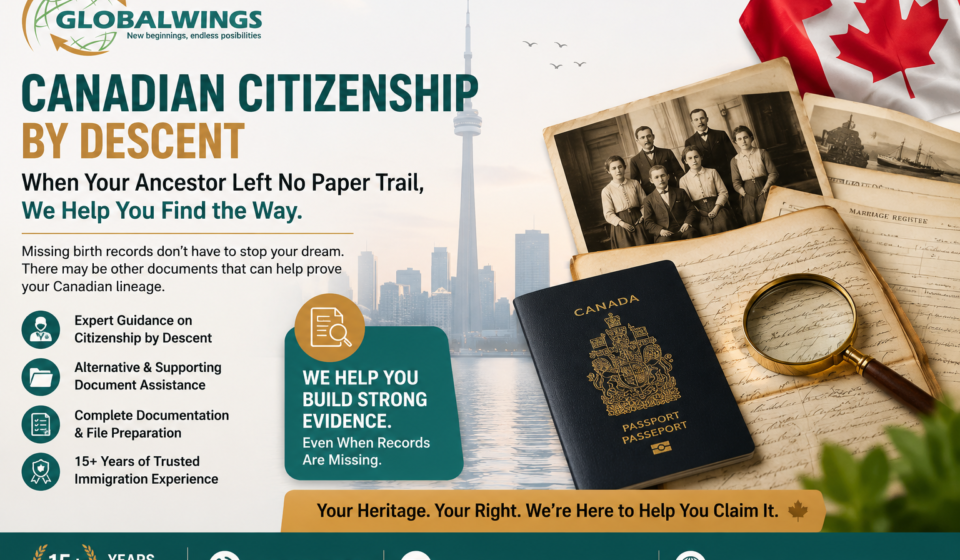

Canadian Citizenship by Descent: What to Do When Your Canadian Ancestor Left No Paper Trail
Applying for Canadian citizenship by descent can be one of the most rewarding ways to reconnect with your family’s Canadian roots. However, many applicants encounter a common challenge: missing historical records.
Imagine finding out that your great-grandparent was born in Canada, only to discover that their birth certificate cannot be located. This situation is more common than many people realize. Older records may have been lost, destroyed, or never officially registered, especially before provincial governments established consistent civil registration systems.
Fortunately, a missing birth certificate does not always mean the end of your citizenship-by-descent journey. While Immigration, Refugees and Citizenship Canada (IRCC) requires official documentation for citizenship applications, there are several ways to strengthen your case using supporting evidence and official records from other family members.
In this guide, we’ll explain how to approach missing ancestral records, what documents IRCC may consider, and how Globalwings Visa Consultants, with 15+ years of immigration experience, can help you build a stronger citizenship application.
Understanding Canadian Citizenship by Descent
Canadian citizenship by descent allows certain individuals born outside Canada to claim Canadian citizenship through a Canadian parent or qualifying ancestor, depending on current Canadian citizenship laws.
To qualify, applicants must establish a clear family relationship between themselves and their Canadian ancestor using official documentation.
This generally includes:
- Birth certificates
- Marriage certificates
- Adoption records (if applicable)
- Legal name change documents
- Death certificates (where relevant)
Each generation connecting the applicant to the Canadian ancestor must be supported with official records.
Why Are Some Canadian Records Missing?
Many citizenship applicants discover that an ancestor’s birth certificate simply doesn’t exist.
Some common reasons include:
- Birth occurred before mandatory civil registration.
- Records were lost due to fire or natural disasters.
- Registration was never completed.
- Historical record-keeping practices differed across provinces.
- Older documents deteriorated over time.
Although this can complicate the application process, it doesn’t necessarily make it impossible.
Don’t Stop at One Missing Record
One of the biggest mistakes applicants make is ending their search after failing to locate a birth certificate.
Instead, broaden your research.
Often, other family members’ official records contain valuable information about your Canadian ancestor.
These may include:
- Siblings
- Children
- Parents
- Grandchildren
- Spouses
Many historical documents identify parents, places of birth, occupations, and family relationships that help confirm your ancestry.
Alternative Records That Can Strengthen Your Application
Although these documents cannot replace mandatory records required by IRCC, they may help establish your family’s Canadian history when combined with official documentation.
Useful supporting records include:
1. Marriage Certificates
Marriage records frequently include:
- Parents’ names
- Birthplaces
- Ages
- Residences
These details can connect multiple generations together.
2. Death Certificates
Death registrations often record:
- Birthplace
- Parents’ names
- Date of birth
- Informant information
These details can support missing historical records.
3. Census Records
Historical Canadian census records can show:
- Entire households
- Family relationships
- Birthplaces
- Ages
- Occupations
These records help establish where your family lived during a particular period.
4. Immigration Records
Passenger manifests and immigration files may include:
- Country of birth
- Previous residence
- Family members
- Parents’ names
These documents can provide additional confirmation of Canadian origins.
5. Naturalization Files
If one of your relatives later became a citizen of another country, their naturalization application may contain:
- Birthplace
- Parents’ information
- Date of birth
- Previous nationality
Government archives often preserve these files for many decades.
6. Church and Parish Records
Before civil registration became common, churches maintained detailed records of:
- Baptisms
- Marriages
- Burials
These records can sometimes substitute for missing historical information during genealogical research.
Understanding IRCC’s Updated Documentation Requirements
Recent updates have made documentation requirements more rigorous.
IRCC now expects applicants to submit records obtained from the original government authority whenever possible.
Examples include:
- Provincial vital statistics offices
- Provincial archives
- Official government registries
- National archives
Documents downloaded solely from genealogy websites generally aren’t sufficient on their own.
Applicants are also expected to establish every generation connecting themselves to their Canadian ancestor using official evidence.
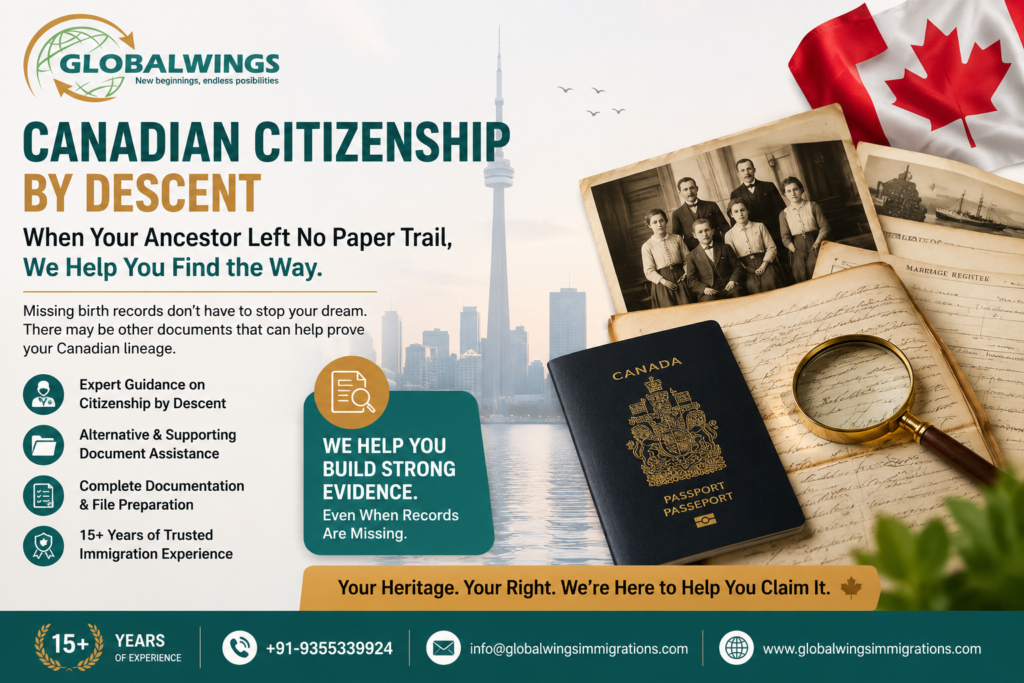
Supporting Evidence Matters
Although official records remain essential, supporting evidence still plays an important role.
Immigration officers review applications based on the balance of probabilities, meaning they determine whether your claim is more likely than not to be true.
Supporting documents can include:
- Historical court records
- Archived government files
- Official affidavits
- Church documents
- Family records
- Government correspondence
When several independent records consistently point to the same facts, they help strengthen your overall application.
Build Your Case Using Multiple Official Sources
Rather than relying on a single document, successful applicants often present multiple records that support the same information.
For example:
- A death certificate listing your ancestor’s Canadian birthplace
- A marriage certificate confirming the same parents
- A census record showing the family living in Canada
- An immigration file identifying Canada as the country of birth
Together, these records create a much stronger application than any single document alone.
Always Document Your Search Efforts
If an official birth record cannot be located, keep evidence showing you attempted to obtain it.
Helpful documentation includes:
- Emails with provincial archives
- Correspondence from vital statistics offices
- Archive search confirmations
- Certified “No Record Found” letters
- Search receipts
A formal No Record Letter demonstrates that you made every reasonable effort to locate the missing document.
When submitted alongside other supporting records, it provides additional credibility to your application.
Common Mistakes to Avoid
Many citizenship by descent applications are delayed because applicants:
- Submit incomplete family trees.
- Skip one generation in the documentation.
- Use unofficial genealogy website printouts only.
- Fail to obtain certified government records.
- Ignore missing record explanations.
- Don’t include supporting evidence.
- Submit inconsistent names or dates without explanation.
Avoiding these mistakes can significantly improve your application’s chances.
Tips for a Strong Canadian Citizenship by Descent Application
To maximize your chances of approval:
- Build a complete family tree.
- Collect official records for every generation.
- Search provincial archives thoroughly.
- Obtain certified copies whenever possible.
- Include alternative government-issued records.
- Keep copies of all correspondence.
- Request No Record Letters when necessary.
- Organize documents chronologically.
- Explain any discrepancies clearly.
- Seek professional immigration guidance before applying.
Why Choose Globalwings Visa Consultants?
Applying for Canadian citizenship by descent can become complex, especially when historical records are incomplete or missing. Professional guidance helps ensure your application is accurate, well-organized, and supported by the strongest possible evidence.
At Globalwings Visa Consultants, we bring 15+ years of experience in helping individuals and families navigate Canadian immigration pathways.
Here’s why applicants trust Globalwings Visa Consultants:
- 15+ years of immigration expertise
- Experienced guidance for Canadian citizenship by descent applications
- Assistance with document assessment and eligibility evaluation
- Support in identifying alternative supporting records
- Step-by-step application guidance
- Personalized consultation based on your family history
- Transparent and ethical immigration advice
- Dedicated customer support throughout your application journey
Whether you’re just beginning your family history research or have already located a Canadian ancestor, our experienced consultants can help you understand your eligibility and prepare a well-documented application.
A missing birth certificate doesn’t automatically prevent you from obtaining Canadian citizenship by descent.
In many cases, official records belonging to siblings, children, spouses, parents, or other close relatives can provide valuable supporting evidence that helps establish your family’s Canadian connection.
The key is to collect as many official records as possible, document your search efforts, explain any missing documents clearly, and present a complete, organized application.
Because every family history is unique, professional guidance can make a significant difference in identifying acceptable evidence and avoiding unnecessary delays.
If you’re unsure whether you qualify for Canadian citizenship by descent or need help gathering historical records, Globalwings Visa Consultants is here to help you navigate every step with confidence.
Frequently Asked Questions (FAQs)
1. Can I apply for Canadian citizenship by descent if my ancestor’s birth certificate is missing?
Yes. While IRCC generally requires official records, you may strengthen your application using supporting documents such as marriage certificates, death certificates, census records, church records, and government archives, along with proof that you attempted to obtain the missing record.
2. What is a No Record Letter?
A No Record Letter is an official document issued by a government archive or vital statistics office confirming that they searched for a requested record but could not locate it.
3. Can genealogy website records be used as proof?
Genealogy websites can assist your research, but records downloaded from these sites alone are generally not sufficient. IRCC expects official records from the original issuing authority whenever possible.
4. What alternative documents can support my application?
Supporting documents may include:
- Marriage certificates
- Death certificates
- Census records
- Immigration files
- Naturalization records
- Church registers
- Government archive documents
- Historical court records
5. Does supporting evidence guarantee approval?
No. Supporting documents strengthen your application but do not guarantee approval. IRCC assesses each case individually based on the evidence provided and applicable citizenship laws.
6. How can Globalwings Visa Consultants help?
With 15+ years of experience, Globalwings Visa Consultants assists applicants by evaluating eligibility, reviewing documentation, identifying supporting evidence, guiding document collection, and helping prepare a complete Canadian citizenship by descent application.
7. How long does it take to gather historical records?
The timeline varies depending on the province, archive, and age of the records. Some documents may be available within weeks, while older archival records can take several months to obtain.
8. Is professional assistance necessary for citizenship by descent applications?
While it’s possible to apply independently, professional guidance can help avoid documentation errors, identify alternative evidence, and improve the quality and completeness of your application, particularly when historical records are missing.