
Canada continues to be one of the most sought-after destinations for skilled workers, students, and families worldwide. In a positive development for immigration applicants, Immigration, Refugees and Citizenship Canada (IRCC) has released updated processing times on June 24, showing significant improvements across several temporary residence categories, especially work permits.
For individuals planning to work, study, or reunite with family members in Canada, these updates offer encouraging news. Faster processing times can help applicants plan their relocation with greater confidence and reduce uncertainty during the immigration process.
At GlobalWings Visa Consultants, we closely monitor every change in Canadian immigration policies and processing trends to help our clients make informed decisions. In this article, we will explore the latest processing time updates, analyze what they mean for applicants, and explain how professional guidance can improve your chances of a successful application.
Canada Work Permit Processing Times Reach a New Low in 2026
Among all temporary residence categories, work permits experienced the most notable improvements.
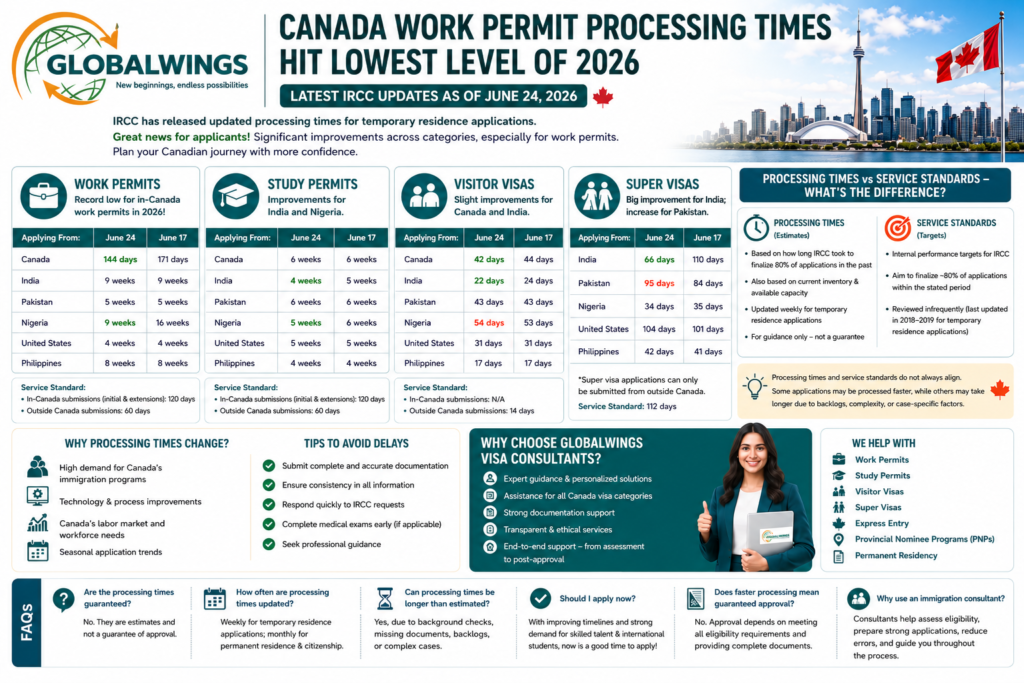
The biggest highlight is that in-Canada work permit applications have dropped to 144 days, marking the lowest processing time recorded in 2026 so far. This represents a significant improvement from the previous estimate of 171 days.
Similarly, applicants from Nigeria saw an impressive reduction in processing times, with wait periods dropping by approximately seven weeks.
Current Work Permit Processing Times
| Applying From | June 24 | June 17 |
|---|---|---|
| Canada | 144 days | 171 days |
| India | 9 weeks | 9 weeks |
| Pakistan | 5 weeks | 5 weeks |
| Nigeria | 9 weeks | 16 weeks |
| United States | 4 weeks | 4 weeks |
| Philippines | 8 weeks | 8 weeks |
What This Means for Applicants
The reduction in processing times reflects ongoing efforts by IRCC to improve efficiency and reduce application backlogs.
For applicants already in Canada, faster processing means:
- Quicker access to work authorization.
- Reduced uncertainty regarding employment status.
- Easier transition between employers where applicable.
- Improved planning for permanent residency pathways.
For overseas applicants, stable processing times indicate that Canada continues to prioritize skilled workers to support its labor market needs.
Study Permit Processing Times Show Positive Movement
International students continue to play a critical role in Canada’s economy and workforce development. The latest updates show slight improvements in study permit processing times for applicants from India and Nigeria.
Current Study Permit Processing Times
| Applying From | June 24 | June 17 |
|---|---|---|
| Canada | 6 weeks | 6 weeks |
| India | 4 weeks | 5 weeks |
| Pakistan | 6 weeks | 6 weeks |
| Nigeria | 5 weeks | 6 weeks |
| United States | 5 weeks | 5 weeks |
| Philippines | 4 weeks | 4 weeks |
Why This Matters
India remains one of Canada’s largest sources of international students. A one-week reduction may seem small, but it can significantly impact students preparing for upcoming academic intakes.
Faster study permit approvals allow students to:
- Secure housing arrangements earlier.
- Prepare travel plans with confidence.
- Meet college and university enrollment deadlines.
- Focus on academic preparation rather than immigration uncertainties.
For students targeting future permanent residency opportunities through programs such as the Post-Graduation Work Permit (PGWP) and Express Entry, timely study permit approvals are especially important.
Visitor Visa Processing Times Improve for Some Applicants
Canada welcomes millions of visitors each year, including tourists, business travelers, and family members.
Recent IRCC updates indicate modest improvements in visitor visa processing times for applicants from Canada and India.
Current Visitor Visa Processing Times
| Applying From | June 24 | June 17 |
|---|---|---|
| Canada | 42 days | 44 days |
| India | 22 days | 24 days |
| Pakistan | 43 days | 43 days |
| Nigeria | 54 days | 53 days |
| United States | 31 days | 31 days |
| Philippines | 17 days | 17 days |
Impact on Travelers
For Indian applicants, the reduction in processing time can make travel planning more convenient.
Whether traveling for tourism, family visits, business meetings, or special events, shorter processing periods help applicants:
- Book flights with greater certainty.
- Plan vacations more effectively.
- Attend family events and celebrations.
- Participate in business activities without lengthy delays.
Major Improvement in Canada Super Visa Processing Times
One of the most encouraging updates comes from the Super Visa category.
The Super Visa program allows parents and grandparents of Canadian citizens and permanent residents to stay in Canada for extended periods.
Applicants from India experienced a remarkable improvement, with processing times dropping from 110 days to just 66 days.
Current Super Visa Processing Times
| Applying From | June 24 | June 17 |
|---|---|---|
| India | 66 days | 110 days |
| Pakistan | 95 days | 84 days |
| Nigeria | 34 days | 35 days |
| United States | 104 days | 101 days |
| Philippines | 42 days | 41 days |
Benefits for Families
The reduced processing times are excellent news for families hoping to reunite with parents and grandparents.
A faster Super Visa process means:
- Reduced waiting periods for family reunification.
- More flexibility for long-term family visits.
- Improved opportunities for grandparents to spend time with grandchildren.
- Better support systems for families living in Canada.
For many families, this improvement represents a meaningful step toward maintaining stronger family connections across borders.
Understanding IRCC Processing Times and Service Standards
Many applicants mistakenly assume that published processing times are guaranteed timelines. However, there is an important distinction between processing estimates and service standards.
What Are Processing Times?
Processing times are estimates based on IRCC’s operational data.
They are designed to provide applicants with a realistic expectation of how long applications may take to process.
IRCC uses two primary methods:
Historical Estimates
These estimates are based on the time required to finalize approximately 80% of applications in the past.
Forward-Looking Estimates
These estimates consider:
- Current application volumes.
- Available processing capacity.
- Existing backlogs.
- Resource allocation.
Because application volumes fluctuate throughout the year, processing times can change frequently.
What Are Service Standards?
Service standards represent IRCC’s internal performance targets.
They indicate the department’s goal for processing a certain percentage of applications within a specific timeframe under normal conditions.
Current Service Standards
Work Permits
- In-Canada applications: 120 days
- Outside Canada applications: 60 days
Study Permits
- In-Canada applications: 120 days
- Outside Canada applications: 60 days
Visitor Visas
- Outside Canada applications: 14 days
Super Visas
- 112 days
It is important to remember that service standards are targets rather than guarantees.
Some applications may be approved much faster, while others may take longer depending on:
- Application complexity.
- Background verification requirements.
- Medical examinations.
- Security screening.
- Missing documentation.
- High application volumes.
Why Processing Times Continue to Change
Several factors influence Canadian immigration processing times.
Increased Immigration Demand
Canada remains one of the world’s most attractive destinations for skilled workers and international students.
Growing demand naturally impacts processing volumes.
Technology Improvements
IRCC continues investing in digital processing systems and automation, helping officers review applications more efficiently.
Workforce Requirements
Canada faces labor shortages across numerous industries, including:
- Healthcare
- Information technology
- Construction
- Engineering
- Transportation
- Skilled trades
Faster work permit processing supports Canada’s economic growth by helping employers fill critical positions.
Seasonal Application Trends
Certain periods of the year experience higher application volumes, particularly:
- Student intake seasons.
- Summer travel periods.
- End-of-year holidays.
These fluctuations can influence processing timelines.
Tips to Avoid Delays in Your Canadian Immigration Application
Even as processing times improve, applicants should take proactive steps to minimize delays.
Submit Complete Documentation
Missing documents remain one of the leading causes of processing delays.
Ensure Information Accuracy
Any inconsistencies in application forms can trigger additional review.
Respond Quickly to IRCC Requests
Prompt responses to document requests help keep applications moving forward.
Complete Medical Exams Early
Where applicable, completing medical examinations in advance can reduce waiting periods.
Seek Professional Guidance
Professional immigration consultants can help ensure applications are prepared correctly from the beginning.
Why Choose GlobalWings Visa Consultants?
Navigating Canada’s immigration system can be complex. Rules, eligibility requirements, documentation standards, and processing procedures frequently change.
This is where GlobalWings Visa Consultants can make a significant difference.
Experienced Immigration Guidance
Our team stays updated with the latest Canadian immigration policies and processing trends to provide accurate and reliable advice.
Personalized Solutions
Every applicant has unique goals. We create customized immigration strategies based on your profile, qualifications, and objectives.
Complete Documentation Support
We help applicants prepare strong, accurate, and complete applications to reduce the risk of delays and refusals.
Assistance for Multiple Visa Categories
We provide support for:
- Canada Work Permits
- Canada Study Permits
- Visitor Visas
- Super Visas
- Express Entry
- Provincial Nominee Programs (PNPs)
- Permanent Residency Applications
Transparent and Ethical Services
GlobalWings is committed to maintaining professional standards and transparent communication throughout the immigration journey.
End-to-End Support
From eligibility assessment to application submission and post-approval guidance, we assist clients at every stage.
The latest IRCC processing time updates bring encouraging news for thousands of individuals planning to move to Canada. The significant reduction in work permit processing times, particularly for in-Canada applicants, demonstrates Canada’s ongoing efforts to improve immigration efficiency.
Improvements in study permits, visitor visas, and Super Visas further highlight Canada’s commitment to welcoming international talent, students, and families.
However, while processing times are improving, submitting a complete and professionally prepared application remains critical for success.
If you are planning to apply for a Canada Work Permit, Study Permit, Visitor Visa, Super Visa, or Permanent Residency, GlobalWings Visa Consultants is ready to help you navigate the process with confidence.
Contact GlobalWings Visa Consultants today for expert guidance and take the next step toward achieving your Canadian immigration goals.
Frequently Asked Questions (FAQs) About Canada Work Permit and Visa Processing Times
1. What is the current processing time for a Canada work permit in 2026?
As of the latest IRCC update, work permit applications submitted from within Canada are being processed in approximately 144 days, the lowest processing time recorded in 2026 so far. Processing times for applicants outside Canada vary by country, with Indian applicants currently experiencing an average processing time of around 9 weeks.
2. Why do Canada work permit processing times change frequently?
IRCC updates processing times based on several factors, including:
- Number of applications received.
- Current application backlog.
- Available processing staff and resources.
- Seasonal demand.
- Complexity of applications.
Because these factors constantly change, processing times are updated regularly and should be viewed as estimates rather than guarantees.
3. What is the difference between processing times and service standards?
Processing times are estimates based on IRCC’s current workload and historical data.
Service standards are internal targets set by IRCC that indicate how long it aims to process most applications under normal circumstances.
For example, the service standard for an in-Canada work permit application is 120 days, but actual processing times may be shorter or longer.
4. How can I reduce delays in my Canada work permit application?
To avoid unnecessary delays:
- Submit all required documents.
- Ensure your forms are completed accurately.
- Provide clear and truthful information.
- Respond quickly to IRCC requests.
- Complete medical examinations when required.
- Seek guidance from experienced immigration professionals.
5. Are Canada study permit processing times improving?
Yes. Recent IRCC updates show improvements in study permit processing times for applicants from countries such as India and Nigeria. Indian study permit applications are currently being processed in approximately 4 weeks, making it easier for students to prepare for upcoming academic intakes.
6. What is a Canada Super Visa?
The Canada Super Visa allows parents and grandparents of Canadian citizens and permanent residents to visit Canada for extended periods. Unlike a regular visitor visa, the Super Visa offers longer stays and multiple entries over several years.
7. How long does it take to process a Canada Super Visa?
Processing times vary by country. According to recent IRCC updates, Super Visa applications from India are currently being processed in approximately 66 days, a significant improvement from previous estimates.
8. Does a faster processing time guarantee visa approval?
No. Processing times only indicate how long IRCC may take to review an application. Approval depends on meeting all eligibility requirements, submitting complete documentation, and satisfying immigration officers that all program conditions have been met.
9. Can I apply for a Canada work permit without a job offer?
In many cases, a job offer is required for employer-specific work permits. However, certain programs, including some open work permits, may allow applicants to work in Canada without a specific employer. Eligibility depends on individual circumstances and immigration pathways.
10. Why should I use an immigration consultant for my Canada visa application?
Professional immigration consultants can help:
- Assess your eligibility.
- Recommend suitable immigration pathways.
- Prepare accurate documentation.
- Reduce the risk of errors and refusals.
- Provide guidance throughout the application process.
Working with experienced professionals can make the immigration process smoother and more efficient.
11. How often does IRCC update processing times?
IRCC typically updates:
- Temporary residence applications (work permits, study permits, visitor visas, and Super Visas) on a weekly basis.
- Permanent residence and citizenship applications every month.
Applicants should regularly monitor updates to stay informed about current timelines.
12. Why choose GlobalWings Visa Consultants for Canada immigration?
GlobalWings Visa Consultants provides professional assistance for Canada immigration programs, including:
- Canada Work Permits
- Study Permits
- Visitor Visas
- Super Visas
- Express Entry
- Provincial Nominee Programs (PNPs)
- Permanent Residency Applications
Our team offers personalized guidance, documentation support, application review, and end-to-end assistance to help applicants navigate the Canadian immigration process with confidence.
13. Can processing times be longer than the estimated timeline?
Yes. Some applications may take longer than published processing times due to:
- Additional background checks.
- Security screenings.
- Medical examination requirements.
- Missing documents.
- High application volumes.
- Complex case histories.
Applicants should submit complete applications and plan ahead whenever possible.
14. What should I do if my application exceeds the normal processing time?
If your application exceeds the published processing time:
- Check your IRCC online account for updates.
- Ensure no additional documents have been requested.
- Contact IRCC if eligible.
- Consult an experienced immigration professional for guidance on next steps.
15. Is now a good time to apply for a Canada work permit or study permit?
With recent improvements in processing times and Canada’s continued demand for skilled workers and international students, many applicants may benefit from starting their application process now. Early preparation and accurate documentation can help maximize the chances of a smooth and successful application journey.